Wednesday, October 2, 2013

130 Miles of Food

Poached Eggs in Melted Epoisses
Burgundy Road Trip

Imagine you are taking a California road trip.  You are starting in Santa Monica, ultimately destined for San Diego. But before leaving the swaying palms of this famous stretch of beach, you stop for a bite to eat.  It doesn’t really matter which restaurant, diner or taco shack you end up at, in this imaginary Southern California the eateries of this town all serve the same local specialty.  We’ll call this special dish “Eggs Santa Monica”: poached eggs perched atop avocado, oven roasted tomatoes, and a thick slice of grilled country bread.

Fortified, you hop in your car for the 30-mile drive to Long Beach.  You have heard that though Long Beach and Santa Monica fall within the same county lines, there is a completely different specialty here, a dish that has a place on every Long Beach restaurant menu.  We’ll call it, “Eggs Long Beach”: two fried eggs on black beans with pico de gallo. 

So your trip continues, stopping 20 miles later in Newport Beach, 30 miles after that in San Clemente, then Carlsbad, then La Jolla, and finally downtown San Diego.  At each city stop you find a dish that is both completely unique to that town, found in virtually every restaurant in that town, yet almost nowhere outside those town limits.

Winemaker Cyril Audoin (left), me and a travel companion
Sounds a bit wild?  Well for anyone that has traversed the famous routes of France, particularly along the verdant Burgundy corridor, that is pretty much the experience. 

The distance from Chablis, the northernmost part of Burgundy to Macon in the south is approximately 134 miles, the same distance from Santa Monica to San Diego.  In place of the pristine California coastline, the road trip in Burgundy is graced with mile upon mile of some of the world’s best grapevines and, as I found on a recent wine tasting trip, excellent food.

With each village boasting it’s own unique wine identity- from the ancient oyster shell bed that gives Chablis is distinctive taste to sun-ripened chardonnays of the Côte Chalonnaise- perhaps I shouldn’t have been so surprised to find the same proud individuality can be found in their cuisine.

Oeufs meurette- poached eggs in red wine sauce
Just north of the Burgundy border, in a small village in Champagne, the local bistro was serving one of the most famous dishes of its neighbor appellation.  Oeufs meurette, is a dish of poached eggs served in a red wine (classically Burgundy) sauce often with a scattering of bacon lardon.  Here the red wine was reduced down to an unctuous concentration but retained enough acidity to act as a foil for the golden yolk as the punctured sack released its insides.  As I wiped the last drops of the egg and wine sauce from my plate with a torn piece of baguette, it occurred to me that French bread may exist solely for the sopping up of that delicious mess.

A few days later sitting down to an al fresco lunch in Fixin, a village in the north of the Côte d’Or, poached eggs were again on the menu, but here with a whiff of fromage.  On our drive from Chablis to the heart of Burgundy, our car had passed the village of Époisses.  It is in that village that they make a famous orange rind, soft-ripened cow’s milk cheese of the same name. In Fixin the restaurant was serving this cheese, rind removed and melted down to a creamy puddle, as the sauce for two poached eggs.  Our winemaker host, Cyril Audoin of the nearby Domaine Charles Audoin, told us this was a dish we would only find there.  Indeed, as we continued our drive south, never again did I encounter the eggs in Époisses. The decadent slurry of yolk and liquid cheese was left behind, a signpost on the journey.

At this point eggs took a bit of a back seat to meat.  They would reappear further south in the Rhone Valley, notably in a dish of scrambled eggs with black truffle, but for the moment my attention shifted to the cured meats of the region.

Bucolic pasture and vineyard behind Domaine Danjean-Berthoux
If ever there was a way to layer meats in a pan and preserve them- suspended in aspic or sealed beneath a layer of fat- it seems the French have done it all. Burgundy, particularly this mouth-watering stretch of the Cote d’Or, has (surprise) a terrine you can find almost exclusively there: jambon persillé. Unlike its more delicate siblings, this terrine is traditionally made of roughly torn pieces of unsmoked, salt-cured ham (think prosciutto as opposed to Easter ham).  The shredded pork is set with a “jelly” of seasoned white wine and a small forest of parsley.  The result is a lovely mess of a terrine, stunning in the marble of pink meat and leafy green herbs.
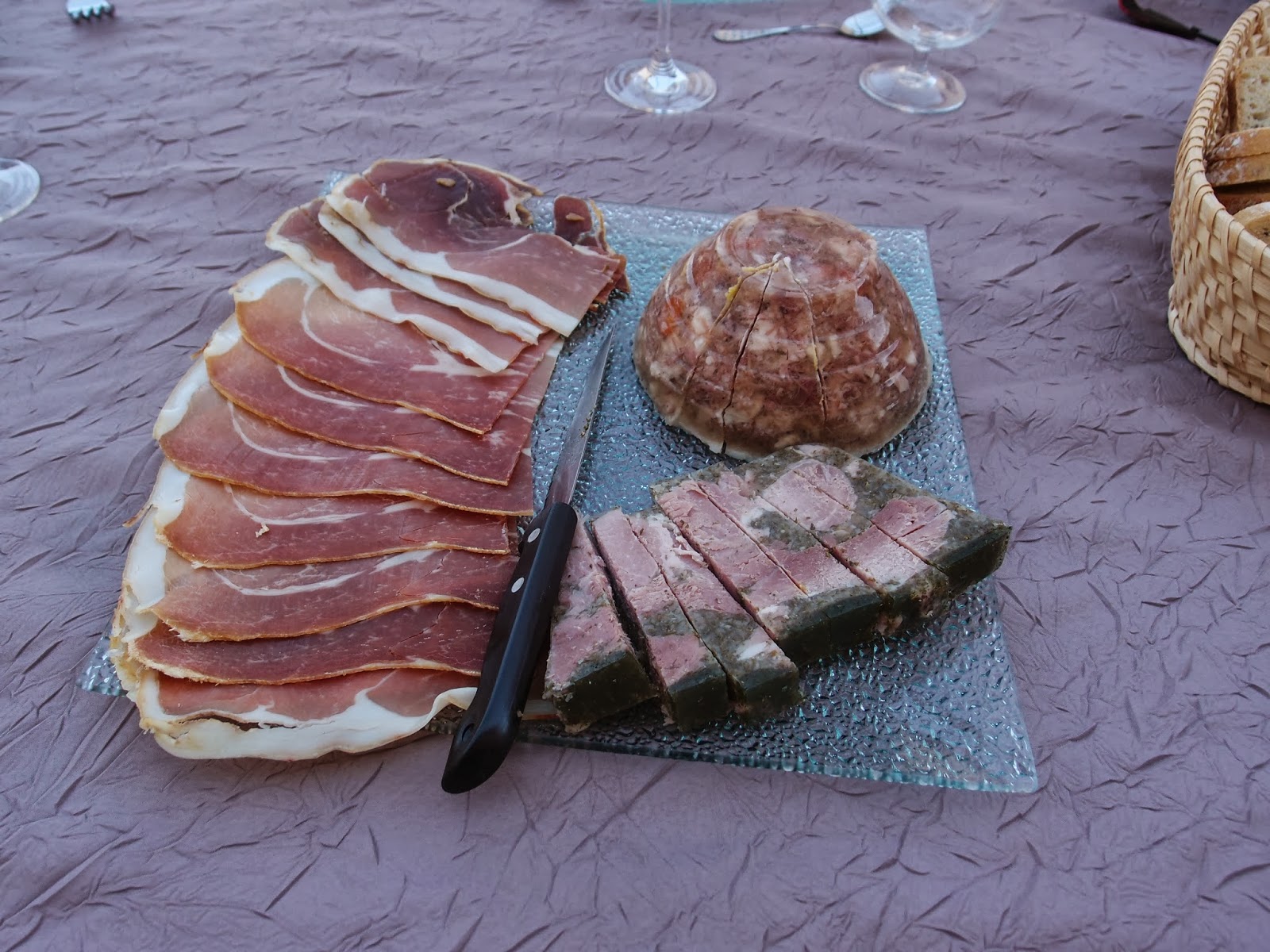
Jambon Persille, right front
Our traveling party found this dish practically everywhere in the Côte d’Or.  At the supermarket in Beaune, we had the butcher cut off a brick sized slab.  We nibbled on the ham for days back in our rented house in Chassagne.  On restaurant menus it was a given that it would appear on a charcuterie spread.  It was no surprise then at lunch in Givry, hosted by winemaker Pascal Danjean, a small bowl-sized jambon persillé materialized as part of our appetizer course, naturally homemade by Pascal’s lovely wife.


It would be near impossible to imagine the drive from Santa Monica to San Diego, or any 130-mile drive in the United States for that matter, claiming as many unique, traditional dishes as I found in Burgundy. To think Burgundy is only one of twenty-seven regions in France.  If a place is best explored through its food, looks like I have some more road trips, and a lot more eating, in my future.

Breaking for a merguez sandwich and Grand Cru Burgundy at a roadside restaurant.
Amy Powell is a food and travel writer based in New York City. She is a graduate of Cornell University's School of Hotel Administration and the French Culinary Institute. Follow her on Twitter @amymariepowell

Friday, September 6, 2013

Raw Summer Squash Salad


Best Thing I Cooked This Week


Friends of mine recently signed up for a CSA share.  You know, that program with the mystery boxes. Community Supported Agriculture they call it.  Once a week people in communities all over America pick up or are delivered a cornucopia of local farmers delights- asparagus and peas in April, corn and tomatoes in August, and the usual assortments of greens and other good-for-you produce. 

But as my friends have discovered, more often than not, their box includes an abundance of certain vegetables that, though they may grow like weeds this time of year, are not part of their regular cooking repertoire for two adults and two children under the age of two.  (“Help!” She once wrote.  “What do I do with all these radishes?”)

On the upside, the couple has grown increasingly fond of some vegetables they would never have purchased in the past.  Kohlrabi, for instance, now regularly gets sliced and added to stir-fries.   

But sometimes, particularly in this abundant time of the year, the mystery box overwhelms their culinary imagination and leaves them facing an unused pile of produce with no clue what the next move should be.

After a recent visit I was the beneficiary of my friends’ excess, helping them to make a smoky eggplant dip out of an oversized version of the purple nightshade.  I also took home several summer squash and zucchini vowing to use it in a way that would be novel for me.

As a child, the texture of cooked zucchini and yellow squash led me to dramatic gagging episodes at the dining room table.  (I have only somewhat matured past that stage.) A raw salad on the other had would protect against any displeasing texture and bring new possibilities for seasoning with fresh herbs, nuts, and maybe even cheese.

The mandolin made quick work of the squash, slicing it into paper-thin sheets in a matter of minutes.  I then squeezed over the juice of a couple lemons and let the two hang for a couple of hours.  The acid from the lemon was just strong enough to gently soften the squash without disintegrating.  To finish dressing the salad it needed little more than good olive oil, salt, and pepper.  As I had some basil on hand I tossed in a good handful of torn leaves.  For crunch I threw in some slivered almonds.  Finally for a bit of tang, some crumbled cotija cheese.

That night a few girlfriends who were over for dinner gobbled the salad down.  Two days later, I made another batch for myself for a light lunch.  The combination of squash, cheese, nuts and herbs I settled on was delightful but I could have easily substituted pine nuts for the almonds, parsley or mint for the basil, and feta or shaved parmesan for the cotija and would have been perfectly happy.  Between the CSA’s, farmer’s market and friends’ personal gardens, I’m sure I’ll have plenty of chances to keep experimenting.


Raw Summer Squash Salad
Serves: 4

1 large zucchini
1 large yellow summer squash
2 lemons
3 T. olive oil
Salt 
Pepper
handful of basil, torn or cut in a chiffonade
1 oz. Cotija cheese (feta would be nice, as would shaved Parmesan)
¼ cup slivered almonds

Slice the zucchini and yellow squash thin on a mandolin or with a thin, sharp knife.  Squeeze the juice of two lemons over.  Let sit for a couple of hours until the squash has softened a bit and soaked up the lemon.  Toss with olive oil, basil, crumbled cheese, almonds, and salt and pepper to taste.  

Amy Powell is a food and travel writer based in New York City. She is a graduate of Cornell University's School of Hotel Administration and the French Culinary Institute. Follow her on Twitter @amymariepowell


Tuesday, July 16, 2013

Vacation Smackdown

 OR, How to Eat Your Way to a Holiday
Sri Lankan Pork Curry and Curried Green Beans

There are many ways to choose a vacation, but few (at least that I’ve heard of) involve a weekend-long smackdown.  Needless to say, John and I have never been the types to take travel lightly.  Our holiday destination this year wouldn’t just present itself in the form of a friend’s wedding, or family reunion.  No, our vacation location would have to work for it. 

Several months ago we had been tossing a few ideas back and forth for a late June holiday.  We knew some serious discussions would need to be had, and fast, if we were going to book flights and rooms before prices turned astronomical.  After batting around a few locales (Burma- monsoon season, Peru- winter, Nepal- too hot) we whittled the global list of possibilities down to a surviving two.  Sardinia has long loomed in our gustatory and beach fantasies and yet never had either of us set foot on those fabled sandy shores.  On the other hand, both of us had been to Sri Lanka, but we had such a good time on our last visit, we considered visiting for a second time in just two years.

With no clear champion between the finalists, John decided the best way to form a conclusion was to have the countries face off in a weekend-long analysis of the pros and cons.  We were having a vacation-off. 

Geographically and culturally Sri Lanka and Sardinia fall on opposite ends of the spectrum.  So to measure these against each other we decided on some clear categories for comparison- logistics (flight times, number of legs), cost (flights, hotels, in-country transport, expected food prices), and (obviously) food.  It is worth mentioning that because Sri Lanka and Sardinia are both blessed with the sort of fairy tale beaches one thinks only exists in the glossy pages of travel magazines, we called the beach requirement a draw. 

Surprisingly, even though Sri Lanka is a full 4000 miles further away from New York than Sardinia as the crow flies, it was not necessarily quicker to get to.  Limited flight times and the number of connections meant total travel time to either destination was about the same. 

As for cost, Sri Lanka would be the more expensive plane ticket.  However, we read enough travel blogs to know that we should expect to pay handsomely for mere decent accommodations during the Sardinian high season.  And food, well, even if a plate of pasta in Sardinia is cheap for Italy, nothing can beat the $6 per person curry and rice specials in Sri Lanka where dishes emerge from the kitchen in quantities no person in their right mind could finish.

Cookbooks used for reference in the cooking smackdown
That just left the cuisine.  Since we are not the types to travel to Thailand and end up eating at a German schnitzel restaurant, the local foods would need to be meals we not just tolerated but loved.  So it was we started the weekend with the Sardinian specialty, fregola, and finished the smack down with a Sri Lankan pork curry. 

The fregola I cooked slowly with diced tomatoes, sweet sausage, and chorizo.  I stirred in parsley at the end for a good herbal kick.  John lapped up his dish and declared that it should be a permanent additional to our household dinner rotation. 

Two days of research and debate later I was working on our pork curry lunch when it hit me.  I’d made up my mind where we should go this summer.  But first we needed to eat. 

Fregola with sweet sausage and chorizo
John had been out running errands and walked back into our apartment to find the powerful aromas of cinnamon, ginger, and lemongrass wafting from a wok where the aromatics were simmering away with cubes of lean pork shoulder.  I stood back from the stove as he leaned over to inspect my work and dip his finger in the sauce for a taste.  

“I think I know what we should do.”

He cocked an eye.  “Really?”

“Yep.”  I handed him a fork and he speared a cube of meat.  He tipped his head back and closed his eyes. A look of blissful meditation passed over him while he chewed.  He let out a slight groan and slowly fluttered open his lids.  “Want to guess?” 

A smile crossed his face.  “Well, if you’re thinking what I’m thinking right now….” 

The aroma of cinnamon, fiery heat of the curries, beauty of the white sandy beaches, and smiling faces of the people on this Pearl of the Indian Ocean were all calling our names.  For this year at least, the smackdown was settled and Sri Lanka declared the victor.

Sri Lankan Spiced Pork
(adapted from “The Exotic Tastes of Paradise” by Felicia Wakwella Sorensen)

2 lb. lean, boneless pork shoulder, cut into 1 inch cubes
Salt
Pepper
3 T. vegetable oil
3 shallots
1 inch piece of ginger
3 cloves garlic
6 curry leaves, or 3 bay leaves
2 inch piece lemongrass
2 inch piece cinnamon
1 T. paprika
1 T. ground coriander
1 T. ground cumin
1 tsp. chili powder
¼ cup white vinegar
1 ½ c. water

Pat pork cubes dry.  Season on all sides with salt and pepper.  Heat oil in a large wok over medium high heat.  Working in four batches, brown pork on all sides.  Remove browned pork to a platter using a slotted spoon and repeat with remaining uncooked pork.  While pork is browning, peel and thinly slice shallots. Peel ginger and julienne.  Peel garlic and finely chop.  Once all pork is browned and resting on the platter, add shallots, ginger and garlic to the wok (if wok is dry, add additional 1 T. vegetable oil).  Stir fry garlic and ginger for two minutes until fragrant.  Add curry leaves, lemongrass, cinnamon stick, paprika, coriander, cumin, and chili powder. Stir-fry for another 60 seconds until fragrant.  Add vinegar, water, and browned pork to the pan.  Bring to a simmer then cover with a lid and reduce heat to medium low.  Cook covered until pork is very tender, about forty-five minutes.  Remove lid and return heat to medium high.  Simmer until liquid has reduced to a thick sauce.  Taste and adjust seasoning with additional salt and pepper if desired.  Serve with rice. 


Amy Powell is a food and travel writer based in New York City. She is a graduate of Cornell University's School of Hotel Administration and the French Culinary Institute. Follow her on Twitter @amymariepowell